1. Screen the car before you travel
Ask the seller for the full 17-character VIN, current mileage, title status, reason for selling, ownership length and known mechanical or collision issues. A seller who will not provide the VIN or basic documents is asking you to spend time before giving you the information needed to evaluate the listing.
Compare the asking price, trim, equipment and condition with similar vehicles, but do not treat a low price as proof of value. Save the listing and seller messages so you can compare later claims with the vehicle, report and purchase documents.
- Confirm whether the seller is the titled owner or an authorized dealer.
- Ask whether the title is clean, branded, electronic, financed or held by another party.
- Request maintenance records and any repair invoices before the appointment.
- Arrange to meet in daylight at a location suitable for an inspection and test drive.
2. Check the VIN number and vehicle identity
A VIN check before purchase begins with identity. Compare the VIN in the listing and report with the lower driver-side windshield, driver-door certification label, title and registration. The year, make, model, body style and engine description should also match the physical car.
Look for loose fasteners, damaged labels, inconsistent typefaces or a plate that appears altered. A simple transcription mistake can return the wrong car history report; a physical or document mismatch can indicate a more serious problem. Stop until every character and document is reconciled.
- Photograph the visible VIN and labels with the seller’s permission.
- Use the NHTSA VIN decoder to confirm basic manufacturer information.
- Do not accept a partial VIN for the final vehicle-history and document review.
- Make sure the VIN printed on the final bill of sale is exact.
3. Check the car history before buying
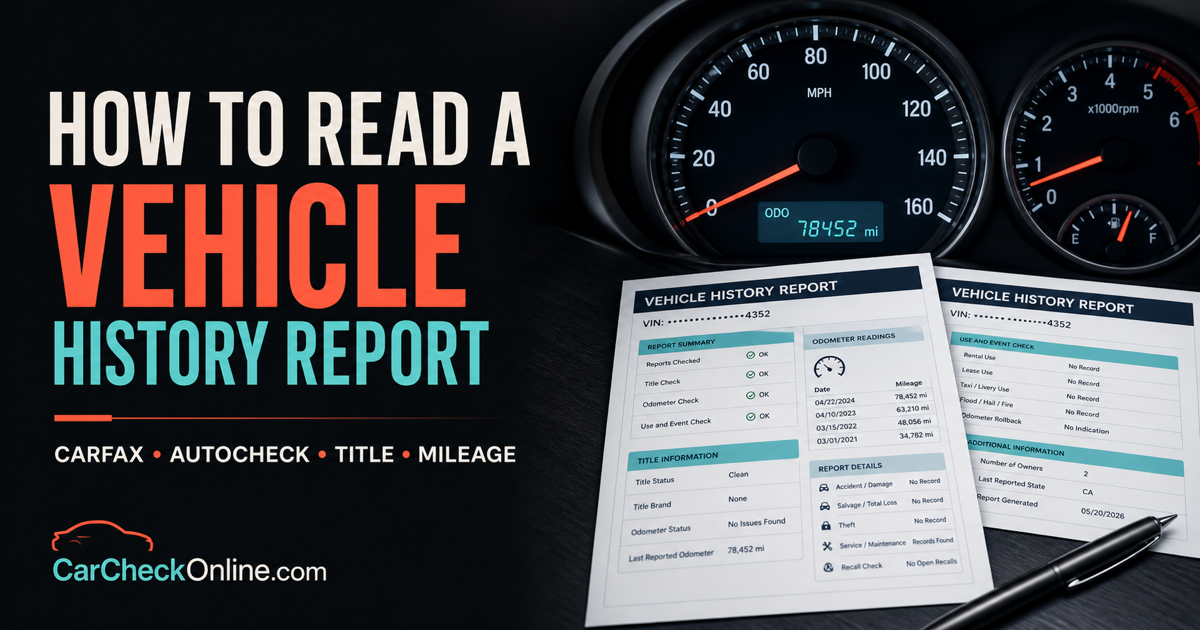
Read the vehicle history report from oldest event to newest. Review title brands, reported accidents or damage, odometer readings, owner and prior-use records, service entries, auctions, theft or recovery indicators and recalls. The goal is not to find a single green badge; it is to see whether the records tell a consistent story.
A report reflects records available to that report. The absence of a matching damage event is not proof that no damage occurred, and a report does not diagnose today’s engine, transmission, electronics or structural condition. Use each signal to choose the next document, question or inspection step.
- Investigate salvage, rebuilt, flood, junk, lemon and odometer-related title brands.
- Compare every dated mileage entry rather than relying on the latest number.
- Ask for repair documentation when accident, damage or auction records appear.
- Verify open recalls directly with NHTSA or the manufacturer.
4. Verify title, ownership, liens and records
Read the original title instead of relying on a photograph when possible. Confirm the seller’s identity, VIN, title number, mileage disclosure and brand fields. Follow the process required by the state where the vehicle will be titled, especially when the title is electronic, belongs to a lender or comes from another jurisdiction.
A vehicle history report supports this review but does not transfer ownership or guarantee that every lien, brand or document problem is resolved. If a payoff or lien release is required, arrange a verifiable process with the lender or relevant agency before funds and possession change hands.
- Match the seller’s name and identification to the ownership document.
- Check for alterations, missing signatures and reassignment limits.
- Compare maintenance dates and mileage with the report timeline.
- Put promised repairs, included items and representations in writing.
5. Inspect the car in daylight and drive it from cold
Ask the seller not to warm the vehicle before the appointment. On a cold start, watch warning lights complete their normal check, listen for abnormal noise and inspect for smoke or leaks. Walk around the car in even daylight and compare panel gaps, paint texture, glass dates, tire wear and underbody condition.
During the test drive, include low-speed turns, braking, rough pavement and highway speed when safe and lawful. Check steering, shifting, vibration, climate control, cameras, driver-assistance warnings and every accessory you expect to receive. Do not let a short loop chosen by the seller substitute for a real evaluation.
- Inspect tires for age, matching specifications and uneven wear.
- Look for moisture, corrosion, odors or silt that could support flood concerns.
- Check oil, coolant and visible fluid condition only when it is safe to do so.
- Compare current condition with damage, use and mileage clues in the report.
6. Get an independent inspection, then decide
The Federal Trade Commission says a vehicle history report is not a substitute for an independent inspection. Choose a qualified mechanic who works for you, provide the report in advance and ask for a written assessment that identifies the vehicle by VIN. A scan for diagnostic codes alone is not a complete inspection.
Combine the report, documents, inspection estimate and test-drive notes before negotiating. Normal maintenance may support a price adjustment; identity, title, structural, flood, unresolved lien or seller-credibility problems may justify walking away. The cheapest purchase is not affordable if its material risks remain unknown.
- Ask the inspector to focus on concerns suggested by the recorded history.
- Price immediate tires, brakes, fluids, recalls and deferred maintenance.
- Verify insurance and registration eligibility before committing to a branded-title vehicle.
- Do not send irreversible payment while a material contradiction remains unresolved.
Used-vehicle buyer report: evidence and next action
Use this compact worksheet to keep the investigation connected. A pass means the evidence agrees; a question mark means the purchase should wait for more proof.
| Check | Evidence to collect | Action if it conflicts |
|---|---|---|
| VIN and identity | Windshield, door label, title, registration, decoder | Stop and reconcile every character |
| Vehicle history | Title, damage, mileage, owners, use, auction and recall timeline | Request documents and targeted inspection |
| Ownership and liens | Original title, seller ID, payoff or lien release | Use the lender or agency process before payment |
| Physical condition | Cold start, daylight walkaround, test drive, records | Price the issue or leave the transaction |
| Independent inspection | Written VIN-specific findings and repair priorities | Recalculate total cost and negotiate or walk away |
Questions to ask before buying the used car
Ask in writing when possible, then compare the answer with the report, documents and inspection.
- Is your name on the current title, and may I compare your identification with it?
- Has the vehicle ever had collision, flood, structural or airbag repair?
- What explains this title brand, mileage change, ownership transfer or auction entry?
- Are there any loans, liens, open recalls, warning lights or known defects?
- Which maintenance or repairs will be due soon, and are the receipts available?
- May my independent mechanic inspect the vehicle before I commit?
Used-car due-diligence questions
What should I check before buying a used car?
Verify identity and ownership, read the vehicle history timeline, inspect the title and records, check recalls, evaluate the car and test drive it, then obtain an independent pre-purchase inspection.
Is a VIN check enough before purchase?
No. It can reveal recorded history and guide your questions, but it does not replace original documents, current-condition checks, recall verification or an independent inspection.
When should I walk away from a used car?
Pause or leave when the VIN or ownership does not match, a lien or title issue cannot be verified, the seller blocks an inspection, material claims conflict, or the risk cannot be evaluated before payment.
Should I buy a vehicle with accident history?
The event alone is not the full answer. Review severity and documentation, verify airbags and structure, obtain a targeted inspection and consider insurance, safety, price and future resale implications.
How current should the vehicle report be?
Run the report close enough to the purchase that new title, mileage, auction or damage records are less likely to fall outside your review, then still verify live recall and document status separately.
Official sources behind the checklist
This guide combines public consumer guidance with primary government tools. Sources reviewed August 16, 2026.
- Buying a Used Car From a DealerU.S. Federal Trade Commission
- Used Cars: Get the Vehicle’s HistoryU.S. Federal Trade Commission
- NMVTIS for ConsumersU.S. Department of Justice
- Understanding a Vehicle History ReportU.S. Department of Justice
- VIN DecoderNHTSA
- Check for RecallsNHTSA
CarCheckOnline.com is an independent report-access and educational service. A vehicle history report contains records available for that VIN and is not a guarantee of condition, ownership, safety or completeness. This guide does not replace legal, title, insurance or mechanical advice.