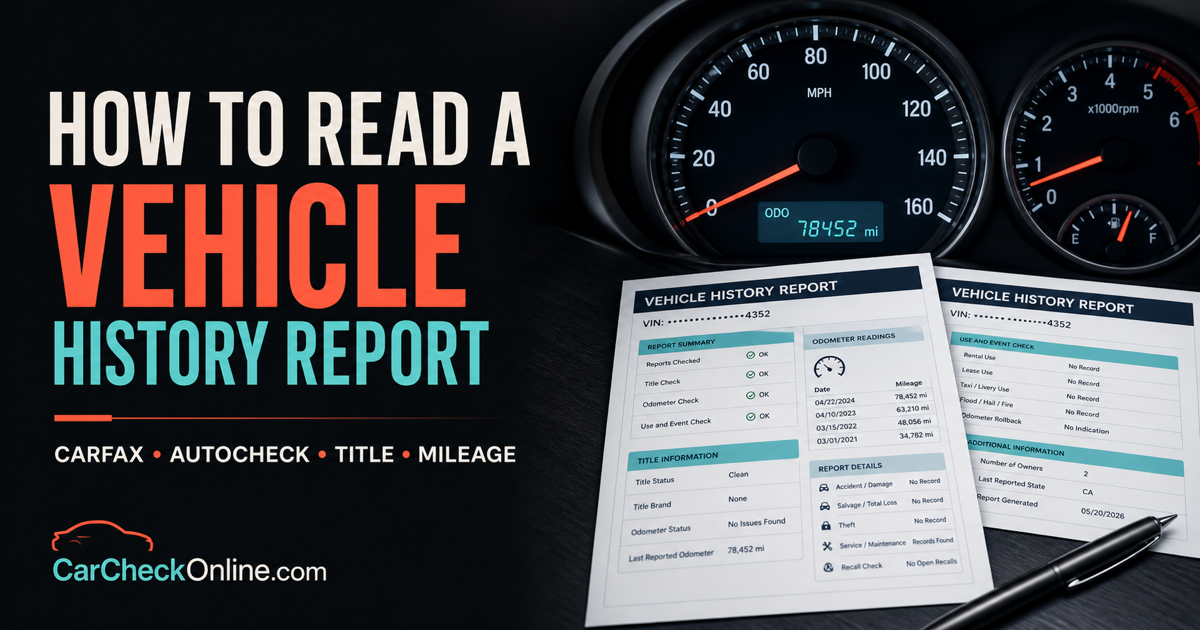
First, verify that the report belongs to the car
Before interpreting any history, compare the full 17-character VIN on the report with the VIN visible through the lower driver-side windshield, the driver-door certification label and the seller’s title or registration. Also match the year, make, model, body style and engine when listed.
A single wrong character can return a different vehicle. If the identity does not match in every location, pause the transaction and ask the seller to resolve the discrepancy before discussing price.
- Confirm the report date so you know how current the search is.
- Check whether the vehicle description matches the listing and the physical car.
- Treat a mismatched or altered VIN plate as a stop signal, not a typo to ignore.
Read title history before accident history
Title brands are labels applied by state motor-vehicle agencies to describe an important past condition. Common examples include salvage, rebuilt, flood, junk, lemon, fire and odometer-related brands. A brand can affect safety, financing, insurance, resale value and whether the vehicle can be registered in another jurisdiction.
Do not look only at the current title status. Read the owner-by-owner or state-by-state title history because a vehicle may have received a brand earlier in its life. State terminology and requirements differ, so a brand should trigger a document review and an inspection by someone familiar with repaired vehicles.
Separate “no record” from “no accident”
Accident sections may show the event date, impact area, damage severity, airbag deployment, structural or frame damage, tow records, insurance loss information and auction announcements. Read the timeline around the event: mileage, ownership and auction activity before and after the damage can add useful context.
The phrase “no accidents or damage reported” means the provider did not receive a matching record from its sources. It does not prove that the vehicle was never damaged. Minor repairs, private payments and events that were not supplied to a data source may be absent.
- Ask for repair invoices, body-shop estimates and before-and-after photos.
- Have the inspector check structure, paint depth, alignment, airbags and driver-assistance calibration.
- Compare the report with auction photos or damage announcements when available.
Read mileage as a sequence, not a single number
Write down each dated odometer reading from title, inspection, service and auction records. The sequence should generally move forward at a plausible rate. A reading that moves backward, a sudden unexplained jump or a long gap followed by unusually low mileage deserves investigation.
Some records may contain clerical errors, and older mechanical odometers can exceed their display limits. That is why an anomaly is a question to resolve, not automatic proof of fraud. Compare the report with the dashboard, service stickers, invoices and wear on the steering wheel, pedals and seats.
Put owners and prior use into context
A report may estimate the number of owners, where the vehicle was titled, the length of each ownership period and whether it was used as personal, rental, fleet, lease, taxi or commercial transportation. None of these labels decides the purchase by itself.
Rental and fleet vehicles can accumulate mileage quickly but may also follow scheduled maintenance programs. A personal vehicle can still be neglected. Use prior use to set expectations for wear and to decide which maintenance records and inspection areas matter most.
- Several very short ownership periods can justify asking why the car changed hands.
- A move between regions can suggest checking for climate-related corrosion or flood exposure.
- Compare the owner timeline with service, title and mileage events for consistency.
Interpret the AutoCheck Score against its comparison range
The AutoCheck Score summarizes multiple history factors, but the number is designed to be viewed against the score range for similar vehicles of the same age and class. Experian’s own example shows why: a numerically lower score can be stronger when it sits well inside or above its relevant comparison range.
Use the score as a navigation aid, then read the title, accident, odometer, auction, owner and use sections. A score cannot explain which event matters to you or whether a repair was performed correctly.
Use service and recall records as leads
Service entries can reveal maintenance rhythm, repeated repairs and where mileage was recorded. A gap does not necessarily mean the work was skipped; the shop may not have supplied data. Ask for receipts and compare them with the report rather than assuming either source is complete.
If a report flags an open recall, verify the VIN directly with the U.S. National Highway Traffic Safety Administration or the manufacturer. Recall repairs are separate from a general mechanical inspection.
End with an independent inspection
The Federal Trade Commission recommends getting a vehicle history report before buying a used car, but it also states that the report is not a substitute for an independent inspection. Reports are strongest at documenting recorded events; they are not designed to diagnose every current mechanical problem.
Give the mechanic the report before the inspection. Point out title brands, accident dates, mileage anomalies, auction records and recurring repairs so the inspection can target the history you already know.
CARFAX and AutoCheck: read the format, not just the logo
The two reports organize information differently. Availability and record depth vary by VIN, so the useful question is which report is available and what its underlying events say.
| Area | CARFAX emphasis | AutoCheck emphasis |
|---|---|---|
| Opening summary | Ownership, reported damage, service, recalls and last reported mileage | Vehicle identity, owner/use summary, score and at-a-glance checks |
| Title review | Owner-by-owner title and odometer brands | State title brands plus auction, insurance and transfer checks |
| Evaluation aid | Narrative overview and chronological details | AutoCheck Score compared with a similar-vehicle range |
| Final step | Open the detailed chronology and investigate each relevant event | Look beyond the score and open every event or issue section |
What a real anonymized example teaches
We reviewed the two sample provider PDFs available on CarCheckOnline and masked their VINs. The point is not to value either vehicle; it is to show how summary lines create follow-up questions.
Anonymized CARFAX example
- 2016 sedan; VIN ending in 0721
- No accidents or damage reported in the provider summary
- 16 service-history records and at least one open recall
- Three estimated owners; first use listed as rental, followed by personal use
- Last reported odometer reading: 108,120 miles
Reading: A clean accident summary does not end the review. The open recall, rental use, ownership changes and service chronology still affect the questions you ask.
Anonymized AutoCheck example
- 2014 compact sedan; VIN ending in 9970
- AutoCheck Score 86; similar-vehicle range shown as 64–81
- Two owners; prior use listed as fleet and rental
- No accident or damage event reported in the summary
- Last reported odometer reading: 113,324 miles; an additional lien event is noted
Reading: The score is strongest when compared with its range, but it does not remove the need to verify the lien, review the mileage timeline and inspect a former fleet vehicle.
Red flags and the right next move
A signal is useful only when it changes what you verify. Use this table to move from observation to action.
| Report signal | What it may indicate | What to do next |
|---|---|---|
| Salvage, rebuilt, flood or junk brand | Major prior condition with possible safety, value or registration impact | Request title documents and repair evidence; use a specialist inspection |
| Mileage moves backward | Clerical error, odometer replacement or possible rollback | Compare dated invoices, title records and physical wear |
| Structural damage or airbag deployment | A higher-consequence repair | Verify repair quality, restraint systems and alignment |
| Repeated auction appearances | Unresolved condition, wholesale movement or prior damage exposure | Review auction dates, photos, announcements and mileage |
| VIN or vehicle description mismatch | Wrong report, documentation error or identity problem | Stop the transaction until every identifier matches |
| Open safety recall | Required manufacturer remedy may still be incomplete | Verify with NHTSA or the manufacturer and schedule the repair |
Questions to ask the seller after reading the report
Send the questions in writing and keep the answers with the purchase documents.
- Can you provide the title and registration so I can confirm the VIN and title status?
- Do you have invoices and photos for the damage or repair event shown on this date?
- What explains this gap or change in the mileage sequence?
- Was the open recall completed, and is there a manufacturer receipt?
- Why did the vehicle change owners or appear at auction during this period?
- May I have the vehicle inspected by an independent mechanic of my choice?
Common questions about interpreting vehicle history
Which is better, CARFAX or AutoCheck?
Neither format is automatically complete for every VIN. Check which report is available, then judge the title, damage, mileage, ownership and event records it actually contains.
Does a clean report mean the car never had an accident?
No. It means no matching accident or damage record was reported to that provider’s sources. Unreported or privately repaired damage may not appear.
What is a good AutoCheck Score?
Compare the score with the range shown for vehicles of similar age and class. The relative position matters more than treating one absolute number as good for every car.
Should I reject every rental or fleet vehicle?
No. Prior use helps set expectations for mileage and wear. Review maintenance evidence and inspect the vehicle’s current condition.
When should I stop the purchase?
Pause when the VIN does not match, important title or lien questions remain unresolved, documentation conflicts with the report, or the seller refuses an independent inspection.
Primary sources and further reading
This guide is based on provider documentation and public consumer guidance. Sources were reviewed on August 7, 2026.
- How to Read a CARFAX Vehicle History ReportCARFAX
- What is the Experian AutoCheck Score?Experian Automotive
- Used Cars: Get the Vehicle’s HistoryU.S. Federal Trade Commission
- Understanding an NMVTIS Vehicle History ReportU.S. Department of Justice
- Check for RecallsNHTSA
CARFAX and AutoCheck are trademarks of their respective owners. CarCheckOnline.com is an independent service and is not affiliated with either provider. Report availability and record depth vary by VIN. This guide is educational and does not replace legal, title, insurance or mechanical advice.